How Smashed Avo Festival Brought Its Council Submissions In-House
Smashed Avo Festival brought council submissions in-house, adding an estimated $50,000 in annual EBITDA and $125,000 in enterprise value.
Arthur runs Smashed Avo Festival in Western Australia. Running a festival is less about the day of the event and more about the paperwork that gets you there: council submissions, grant applications, staff workflows, and the data behind every decision. For a long time, the way Arthur got all of that done was simple and expensive. He did it by hand, or he paid someone else to.
In April 2026 we installed an AIOS, an AI operating system, across the business. Here is what changed.
“It’s all of the brand and all of the company, all in one place.”
— Arthur, Director, Smashed Avo Festival
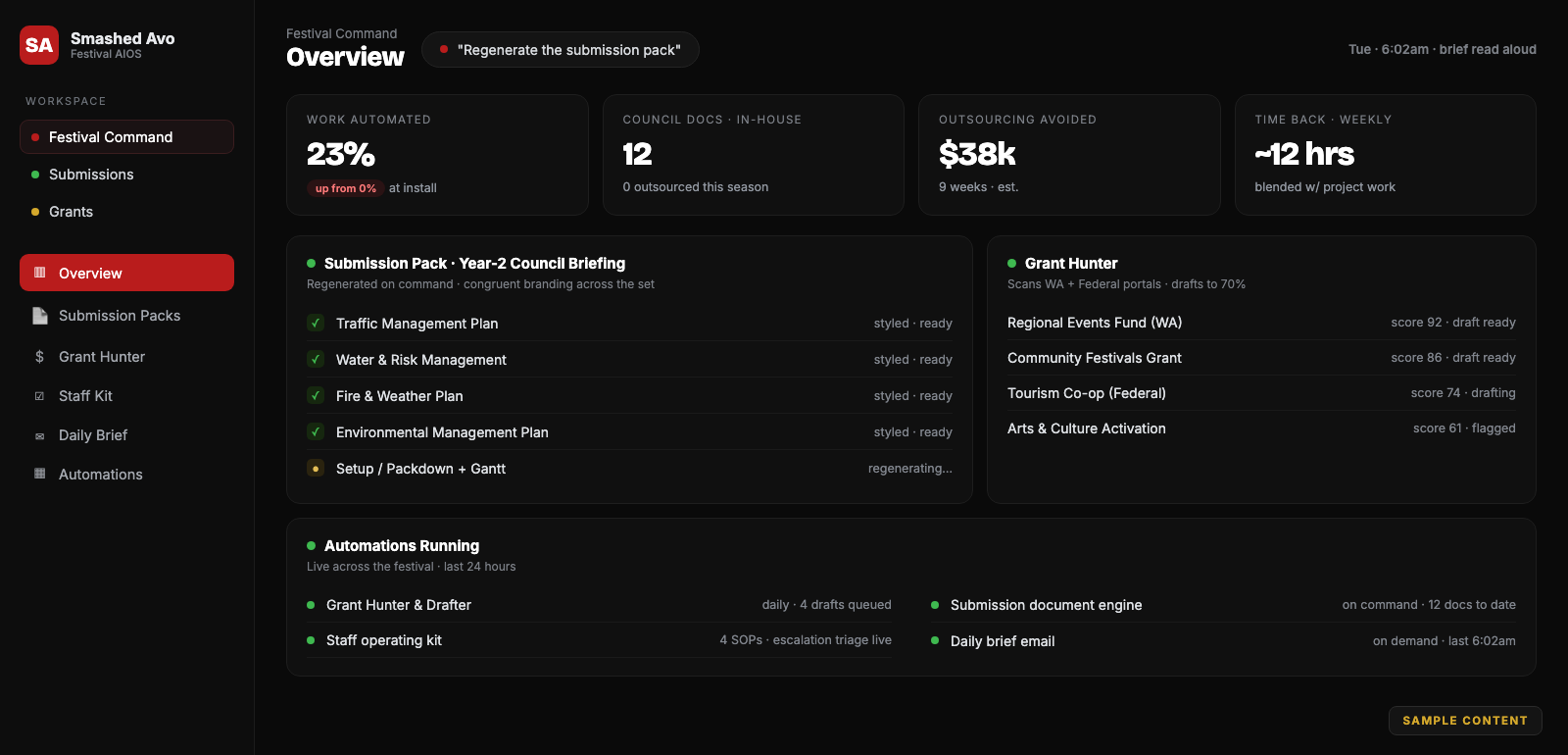
Nine weeks in: His automated work went from 0% to about 23%. The system has produced around 12 council-grade submission documents in-house, work he used to outsource at $3,000 to $5,000 a document. By his own estimate, that is somewhere between $15,000 and $50,000 in outside production he has not had to pay for over those nine weeks. The value translation used in Echelon’s July 2026 capabilities summary records $50,000 in annual EBITDA added and an estimated $125,000 in enterprise value created.
Before: Leading On Gut Feel, Paying By The Document
There was no automation, no CRM, and the finances lived in spreadsheets. Every workflow was manual. The expensive part was never the day-to-day. It was the paperwork that runs a festival.
A single council briefing meant days, sometimes weeks, of collecting data by hand. Turning that into a submission a council would actually accept often went out to an agency at $3,000 to $5,000 a document. Grant applications ran 8 to 15 hours each. Staff SOPs, invoice tracking and weekly check-ins, all manual, all on Arthur.
In his words: “We like to lead a company with data, not with what we feel.” The trouble was that getting to the data took so long it slowed every decision down.
The Install: An AI Operating System For A Festival
We connected his Gmail and calendar, set up a phone-side bridge so he could drive the system by voice from a site or property, and built the layers that hold a festival together: a submission document engine, a grant hunter, a staff operating kit, and a daily brief.
A Day On The AIOS Now
The moment it clicked is a small one. Arthur hand-edits the final version of a council document in Word, then tells the system to regenerate the entire styled submission pack on command. Every document in the set comes back, with congruent branding across all of them. Work that used to be a multi-week, multi-thousand-dollar job is now a single instruction. And he can give that instruction by voice from the festival site, away from the desk.
Underneath, the system does the knowledge work the business used to buy in. A grant hunter scans WA and Federal portals, scores what is worth chasing, and drafts applications to around 70% finished. A staff operating kit turns SOPs, call-escalation and weekly check-ins into a repeatable system. And a daily brief reads back his calendar and yesterday’s decisions each morning.
What It Is Freeing Him Up To Do
The point was never the documents. It was getting Arthur out of the position where every decision waited on data he had to dig for, and every submission waited on a cheque to an agency. Now the data is there when he asks, and the paperwork produces itself.
The line he keeps coming back to says it best: “business strategising is now no longer a hard long mental thought process.”
The stack
- Business: Smashed Avo Festival, an events business in Western Australia
- Connected: Gmail, Google Calendar, plus a phone-side voice bridge
- Automations live: submission document engine, grant hunter and drafter, staff operating kit, daily brief, decisions log and memory layer
The Value Translation
Bringing the submission work in-house adds an estimated $50,000 in annual EBITDA. Using the 2.5× multiple stated in Echelon’s July 2026 capabilities summary, that represents approximately $125,000 in enterprise value created.
If your week is full of paperwork you could describe in plain English, the same kind of system can run it for you. Get In Touch.

Sam co-founded Echelon AI Solutions and leads transformation strategy, client engagements and growth. He has built and operated businesses across marketing and AI education, and has guided companies in retail, trades, hospitality and professional services through operational change. His focus is making AI earn its place through measurable business performance.
More In Case Studies
See all Case Studies →
How Pritesh Hirani Runs Four Businesses From One AIOS
Pritesh Hirani runs four businesses from one AIOS: seven hours a week back, $36,000 in annual EBITDA added, and an estimated $90,000 in enterprise value created.
Read it
How Drapery Co Runs Three Retail Brands From One AIOS
Drapery Co runs three retail brands from one core: about 65% automated, 22 to 30 hours a week back, and an estimated $130,000 in enterprise value created.
Read it